Marie-Josèphe’s court composition
The Moon and the SunMarie-Josèphe’s court composition is the music she creates for a royal entertainment, where it carries her imagination into the court even as others initially misidentify its author. The performance brings her work into public view: Louis XIV finds it charming, Pope Innocent calls it indecent, and the dispute exposes how a woman’s musical authorship can be overshadowed by male authority and religious rules.
The composition and its performance
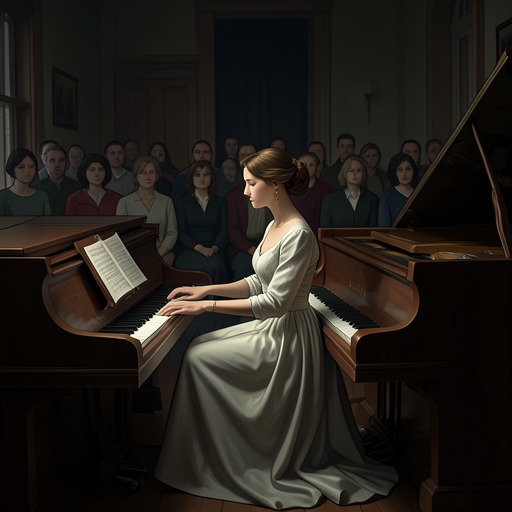
The piece accompanies M. Galland’s reading of his translation, the centerpiece of the King’s entertainment. Marie-Josèphe scarcely attends to the words. She wants to hear her own imagination made real through Domenico Scarlatti, M. Coupillet, and the orchestra. The arrangement gives her music a public sound, but the story being read is not what commands her attention; the melody is.
As it plays, Marie-Josèphe imagines the song moving with the candlelight and painting a world of distant deserts and gardens, dangerous adventures, and unfamiliar scents and songs. The imagery links the piece to the Arabian tale without reducing it to an illustration of Galland’s words. The music gives the story a sensuous atmosphere of its own, while its maker experiences the performance as the realization of music that, for years, had existed only in her mind. The scale of the court performance makes that realization both exhilarating and strange: the sound is hers, but its public form depends on musicians and instruments beyond her control.
The tale’s episode of Scheherazade pleading to live one more night gives the entertainment an especially sharp dramatic edge. Galland’s reading and Marie-Josèphe’s composition conclude together, with Scarlatti’s flourish at the harpsichord. Breathless, she opens her eyes with her heart pounding; elevated by the orchestra and Scarlatti’s performance, the piece seems to her unimaginably wonderful. Her response registers not simply satisfaction with a finished work, but the intensity of hearing an inward musical vision become audible to others.
Authorship comes into the open
The performance initially leaves Marie-Josèphe’s authorship unacknowledged. Louis XIV asks M. Coupillet whether the unfamiliar and charming piece was composed for the occasion. Coupillet confirms that it was, but says nothing to correct the King’s assumption that he composed it. Marie-Josèphe waits in bafflement and then growing outrage as the credit appears to settle on the music master.
Domenico Scarlatti breaks the silence. He tells the King that Signorina Maria composed the piece. His intervention is conspicuous because he is a commoner’s son speaking without being invited to do so. Clutching his gold piece in both hands before his chest, he stares wide-eyed and shrinks back as though he wished he were six again. His nervousness makes the correction a small but consequential act: he risks the breach of court decorum to name the woman whose work has just been performed.
The moment distinguishes composition from performance and patronage. M. Coupillet has led the orchestra, and Scarlatti has played the harpsichord, but neither fact makes the piece theirs. The King’s question shows how readily authorship can be assigned to a male authority figure; Scarlatti’s disclosure makes Marie-Josèphe’s role public. The scene does not show her receiving a formal commission or a lasting change in status. It does show that her work has entered the royal salon under her own name, because another young musician chooses to say so.
Religious condemnation and royal approval
Recognition does not protect the composition from judgment. Pope Innocent calls the piece indecent and argues that its composer should have had the sense to repress it. He invokes the Church’s edict that women should remain silent, then extends the demand beyond church: in his view, music itself injures Marie-Josèphe’s modesty, and the King should censor what he calls pagan excess. His rebuke makes the performance a conflict over women’s right to create and speak, not merely a disagreement about musical taste.
Marie-Josèphe answers by distinguishing the setting in which she understood the rule: she points out that women were required to be silent in church. She already knows that prohibition from the convent’s silence, but Innocent insists that it applies at all times. His position attempts to close the space between religious discipline and public artistic life; her reply marks that boundary as contested. The music has sounded before the court, but the Pope argues that a woman should not have made it sound at all.
Louis XIV answers the condemnation courteously rather than openly escalating the dispute. Before responding to Innocent, he nods to Count Lucien de Chrétien, who gives M. Galland, Domenico Scarlatti, and M. Coupillet heavy leather pouches of coins. The musicians and translator bow and withdraw. The King then again calls the piece charming. His smile toward Marie-Josèphe conveys approval, though the chill of his disapproval toward the Pope remains in the salon. He says the music recalls happier, younger days and a piece he himself once composed. His response protects his favorable judgment of the work, while stopping short of an explicit reply to every part of Innocent’s demand.
Significance
The composition’s importance lies in the collision between what the performance makes audible and what its authorities try to regulate. The court hears a work that Marie-Josèphe has made; the King praises it, while the Pope treats its very existence as a failure of female restraint. Scarlatti’s disclosure matters because the music’s beauty alone does not secure its authorship: someone must name its composer in a room where the King has already credited a man.
The scene also contrasts the music’s imaginative openness with the attempt to confine it. Marie-Josèphe’s inner landscape ranges across deserts, gardens, dangers, scents, and songs, while Innocent’s ruling would restrict her expression to silence. Louis XIV’s approval offers a counterweight, but his praise and reminiscence do not erase the conflict. The performance therefore establishes both a public achievement and a vulnerability: Marie-Josèphe’s musical voice reaches the royal court, yet its reception remains subject to the competing powers of patronage, convention, and religious authority.